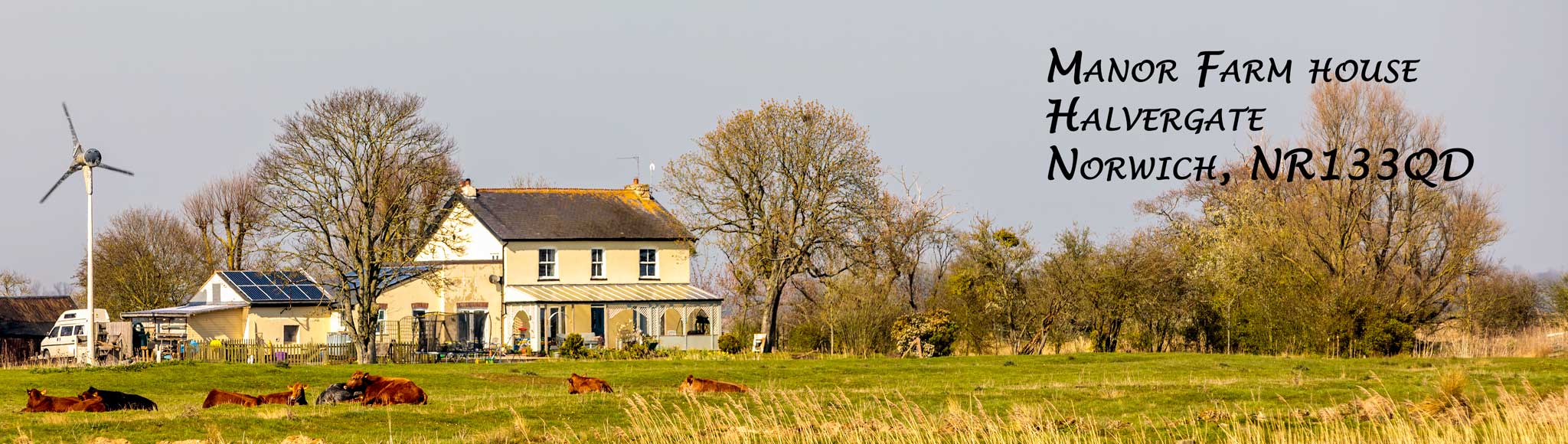
Powering the House
Being off grid and the power system we inherited being totally inadequate. We decided that the best solution was a wind turbine & better batteries followed later by solar panels.
In 2006 after doing some research we decided to install a 6kW Proven Wind turbine, batteries and SMA control equipment.
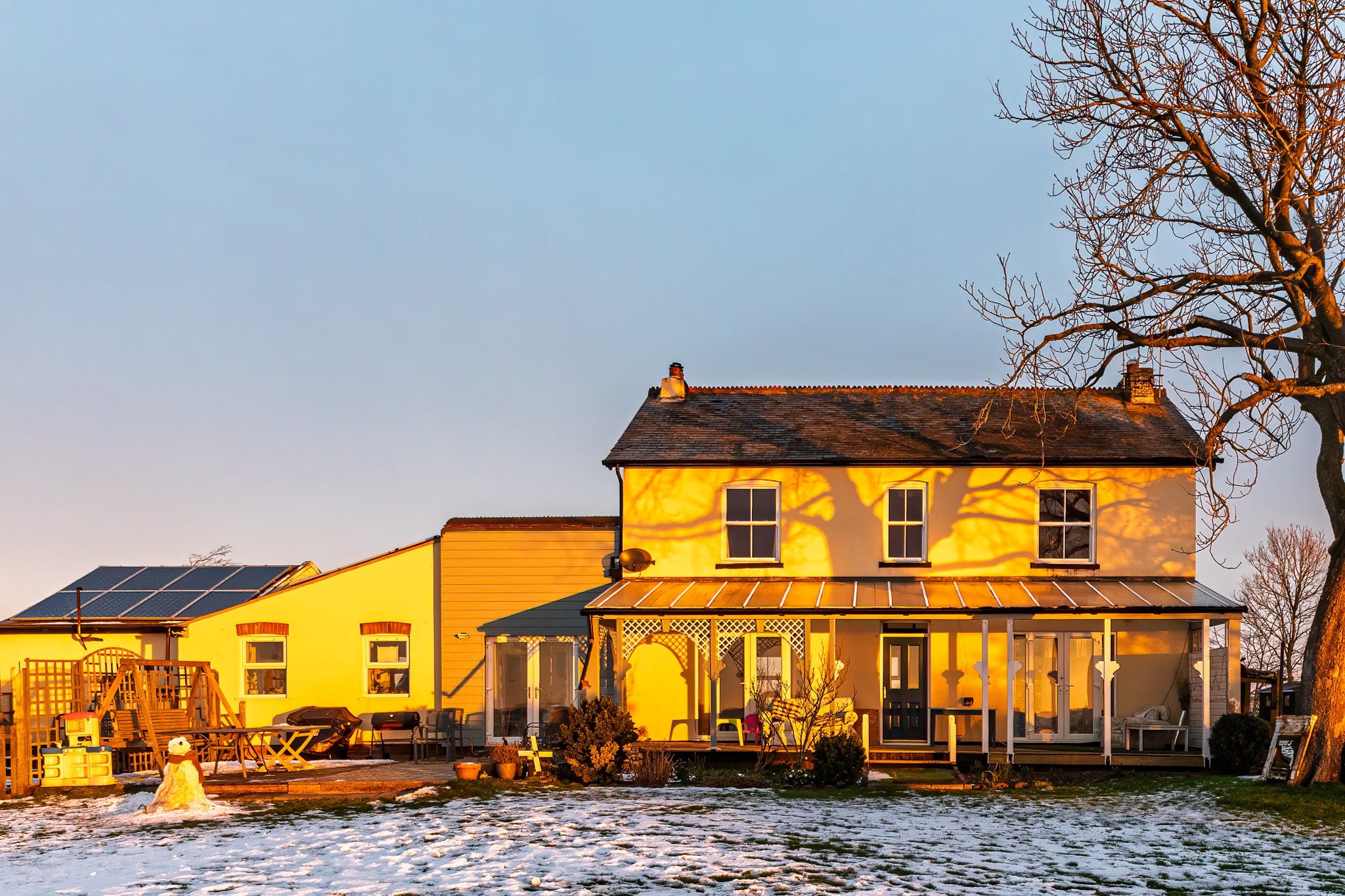 So why in 2006 did we opt for a wind turbine rather than solar? We carried out extensive research before deciding. We did consider solar panels but at that time there were very expensive, although the feed in tariff was 45p per kWh! We decided that the best kW for our buck was a large (for domestic premises) wind turbine. The decision would be different today as the price of solar panels has tumbled. We were early adopters of domestic wind power which bought its own issues. Quite soon after installation I believe I knew more about wind turbines than the installers.
The total installation cost us less than £30,000, this compares with the £115,000 that the electricity board wanted to connect us to the public main — a 2km buried cable from the A47. They couldn't use overhead cables as we are in the Broads National Park.
Driving round the country one does see distinctive Proven wind turbines, but they are not at all common... except in Shetland. We spent 10 days there in May / June 2023 and driving round the islands we saw at least 30.
 The Wind Turbine
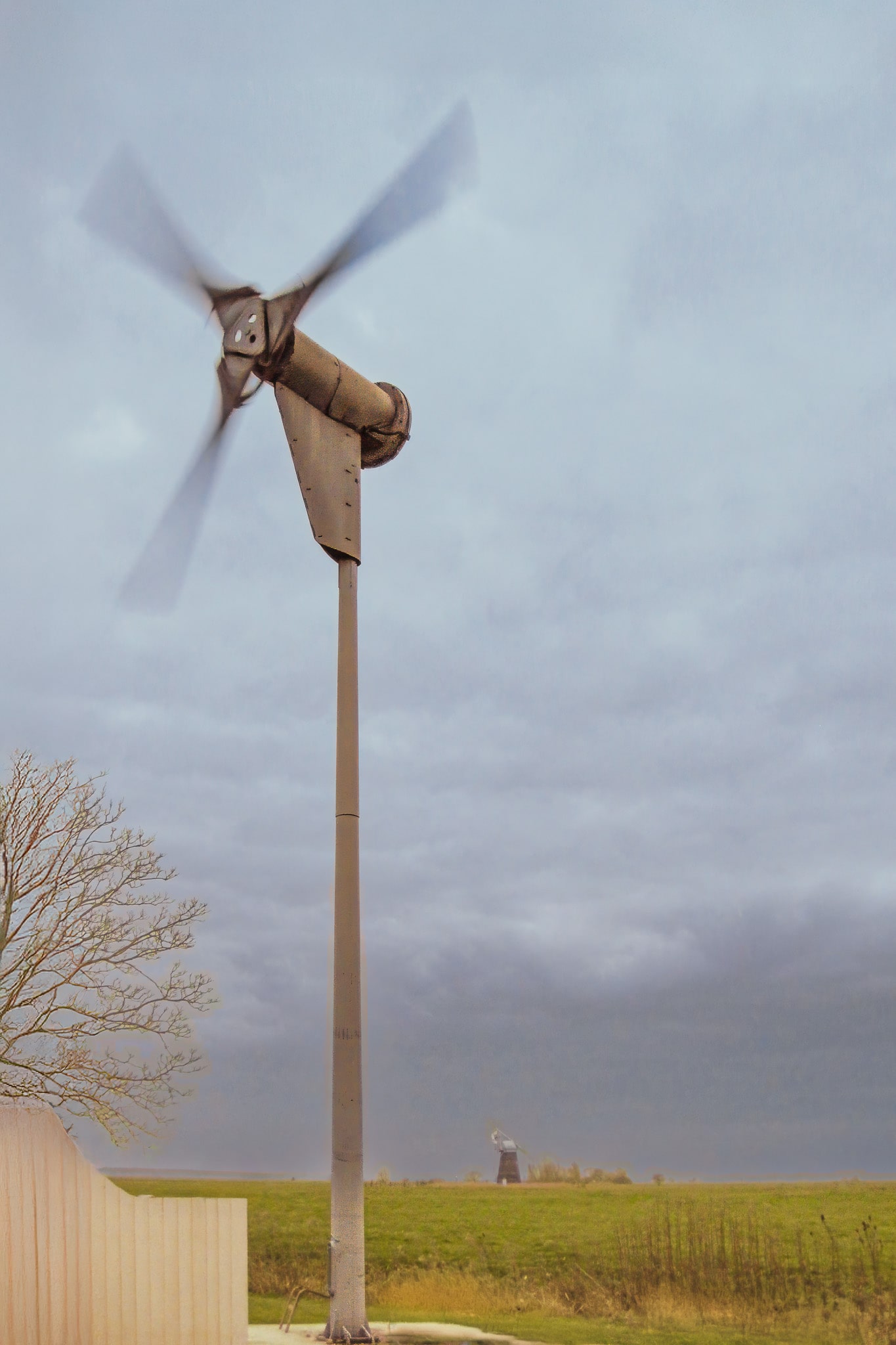
The wind turbine and associated Equipment and batteries were sourced, installed, and commissioned in May 2007 by Bob Coombes and Hugh Keeler of Green Generation As of November 2023 the company still exists but it appears they are no longer trading. The total cost was just under £20,000 after the £5,00 grant from the government.
Andy Hey of Hey Property did a great job of obtaining the appropriate permissions, especially difficult as we are in The Broads conservation area
The wind turbine was made by Proven in Ayrshire, Scotland. Proven turbines were first developed in the 1980s by Gordon Proven to be robust, reliable and able to withstand extreme weather conditions. In October 2011 the firm went into administration and was sold to Kingspan.SD Wind Energy are the current supplier and manufacturer of this design of wind turbine. The basic specification of our wind turbine is:
Proven WT6000 – 6kW (50Hz)
- Turbine type: Proven 6 kW
- Nominal Output: 6kW
- Usage: On-Grid or Off-Grid
- Rotor diameter: 5.57 meter
- Mast Height: 9 meter
We would have preferred a higher (15M ) mast as there more wind the higher up and as generation follows a square law it would have vastly improved our output. However, the Broads Authority planner specified that the maximum height we could have was 11M. Unfortunately Proven only supplied 9M or 15M masts so reluctantly and because we wanted to get the device installed as quickly as possible we chose the 9M. In hindsight we should have just installed the 15M mast and asked for forgiveness if anyone noticed — they never inspected the installation. The planners also specified that it needed to be coloured grey rather than the black (nacelle and blades) and bright galvanised mast as supplied by the factory.
We had some teething problems. The original wood and epoxy blades deteriorated so that in 2008 we had to have them replaced with Kevlar blades at a cost of £1,000/Those blades are still going strong and showing no signs of deterioration as of December 2024. We also had some issues with the control equipment because of a parameter controlling the voltage at which the inverter switched in in was set too low causing oscillations.
Here is a slideshow of the foundations being made and the installation of the Wind Turbine and anchor point.
The device is very simple with just blades, shaft, three phase generator and overspeed springs, no gearing. The simplicity of the overspeed protection which enables the wind turbine to withstand extreme weather conditions is elegant. As strong winds press on the blades obviously they go round faster and generate higher voltages. If the turbine is under load the springs deform feathering the blades, reducing their effectiveness and hence slowing them down. Importantly the turbine MUST be under load.
The prevailing wind across the marsh is from the West and our wind turbine is situated to the West of the house with nothing to obstruct the wind from that direction for at least 2 miles.
Maintenance of the wind turbine is carried out every other year by Geoff Pacey. That involves lowering the device to check for wear, clean it, replace any spring support if required, and grease the bearings.
As of December 2024 the wind turbine has generated 55MWh since February 2009, that is approximately 3.5MWh per year
When the Wind Turbine reaches its end of life — hopefully not for another 10 years at least — we will need to decide how to replace it. There may be an issue before then if we have a failure of the windy boy as SMA withdraw from the small wind turbine industry at the end of 2013 and production of the Windy Boy inverter has ceased.
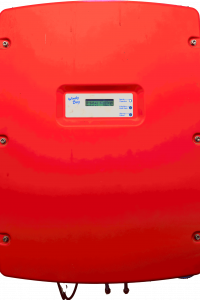 Windy Boy
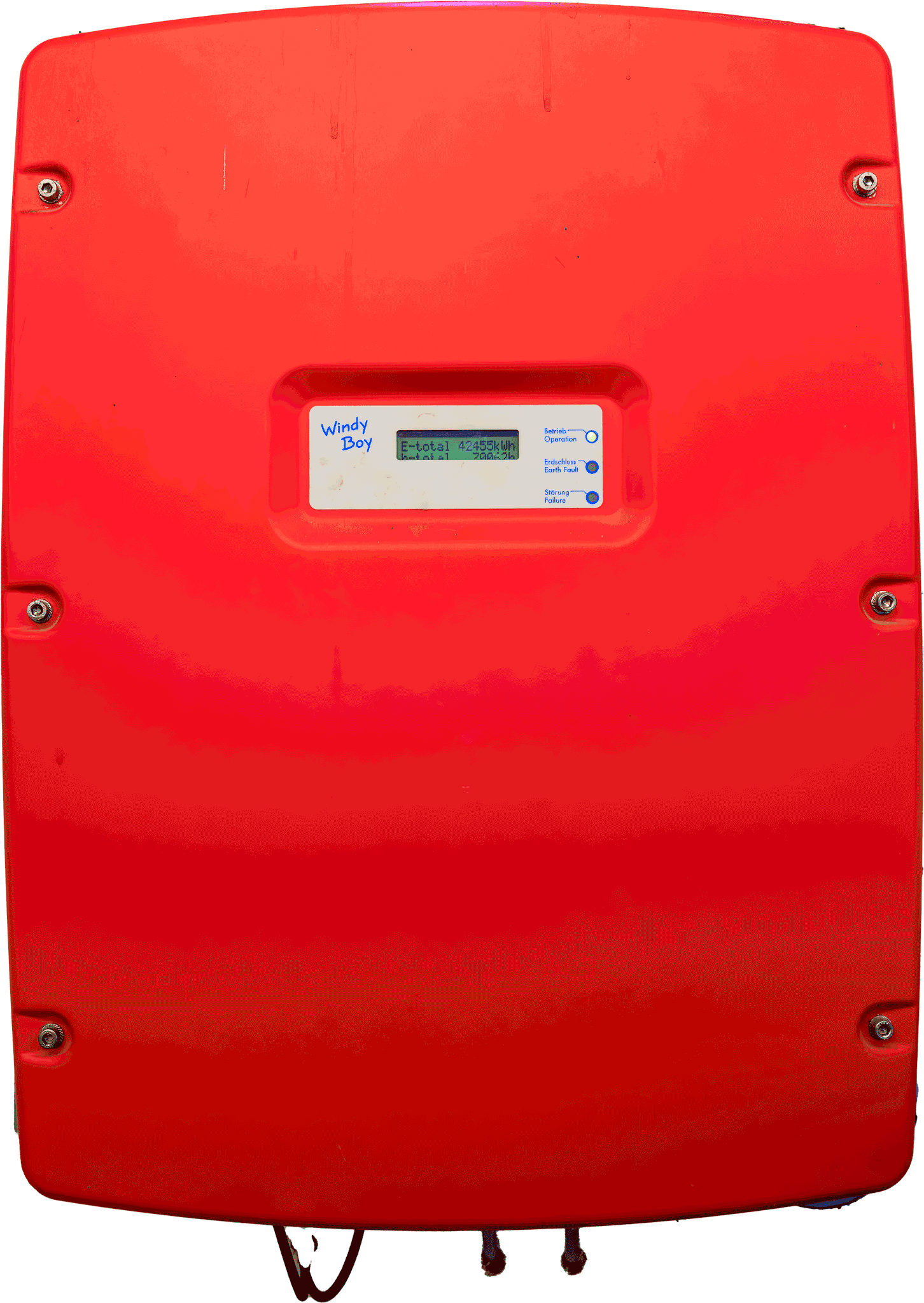
Along with wind turbine we originally installed a Proven turbine rectifier and overvoltage controller plus a SMA Windy Boy WR6KA-15 inverter— yes, I know its a silly name but that is what SMA call them!
The device is registered with SMA, see the online Service Centre https://my.sma-service.com/s/?language=en_US.
The wind turbine produces wild AC, that is three phase AC at whatever frequency the blades happening to be spinning. To turn that into useful power the the Proven turbine rectifies that to DC which in turn is fed into the Windy Boy inverter which inverts the at DC into 240 volts 50Hz usable power. The overvoltage controller is supposed to protect the Windy Boy from excess voltage output from the wind turbine as might happen in very strong winds— the windy Boy input voltage must not exceed 600V DC. It did not work such that we had to change the windy boy a couple of times under warranty as it was damaged by an overvoltage.
We also had immense problems with the equipment switching on and off rapidly. Eventfully it turned out to be wrong parameters set up in the windy boy, we were early adopters. To get the problem diagnosed and fixed SMA sent us two engineers from Germany. However, before we could persuade them to do that we had to replace the Proven turbine rectifier and overvoltage controller with a SMA Windy Boy Protection Box along with a massive 6kW dump resistor.
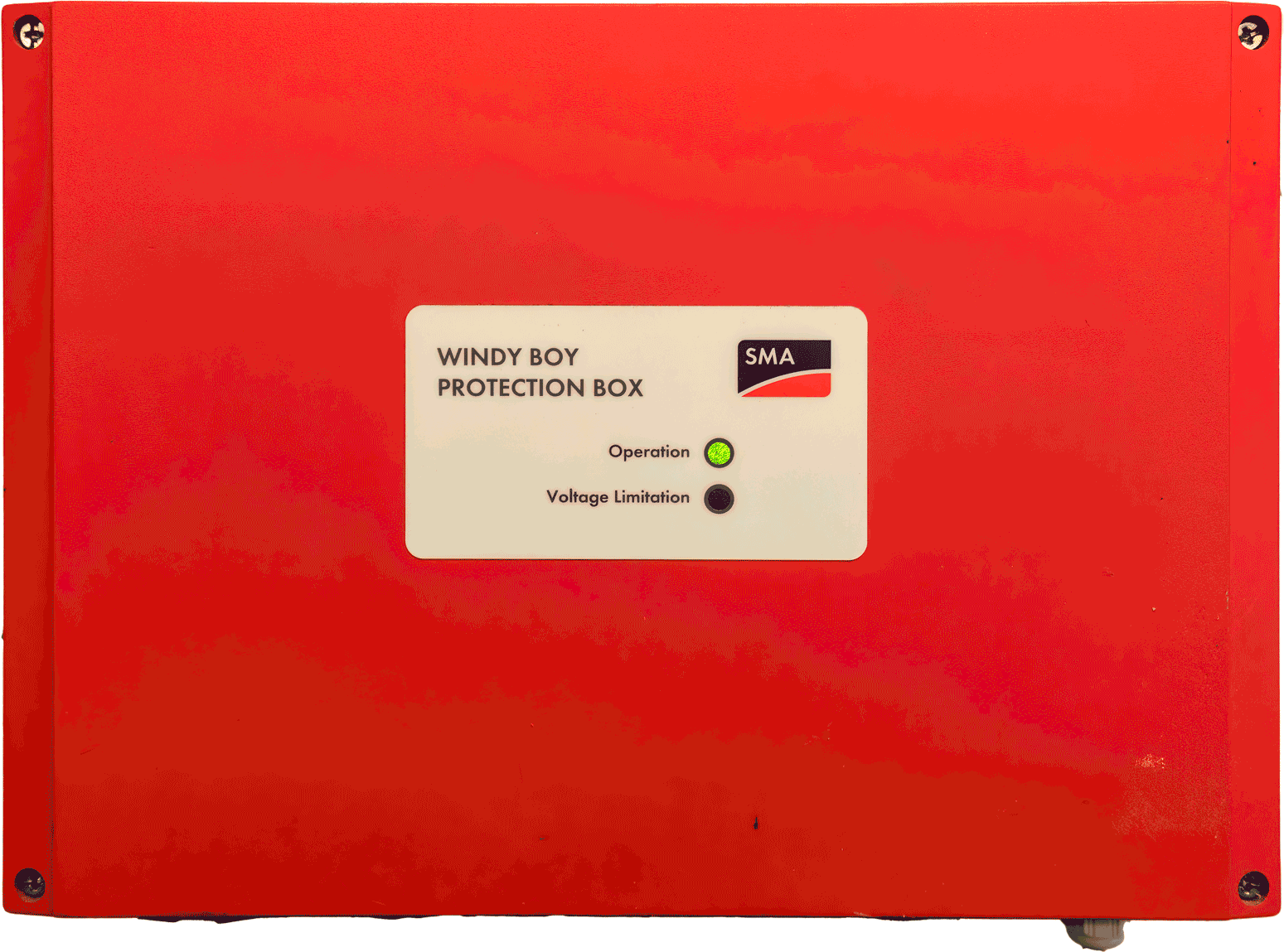 The Windy Boy Protection Box is a rectifier and overvoltage protection box. Like the Proven device the SMA projection box rectifies the wild AC into DC. Unlike the Proven device the overvoltage protection works as it switches the output to the 6kW resistor if the DC output voltage exceeds 600V. Using a 6kW dump resistor maintains a load on the turbine in heavy winds allowing the overspeed springs on the wind turbine to work as designed. The Proven device did not do that.
Solar Panels & Sunny Boy
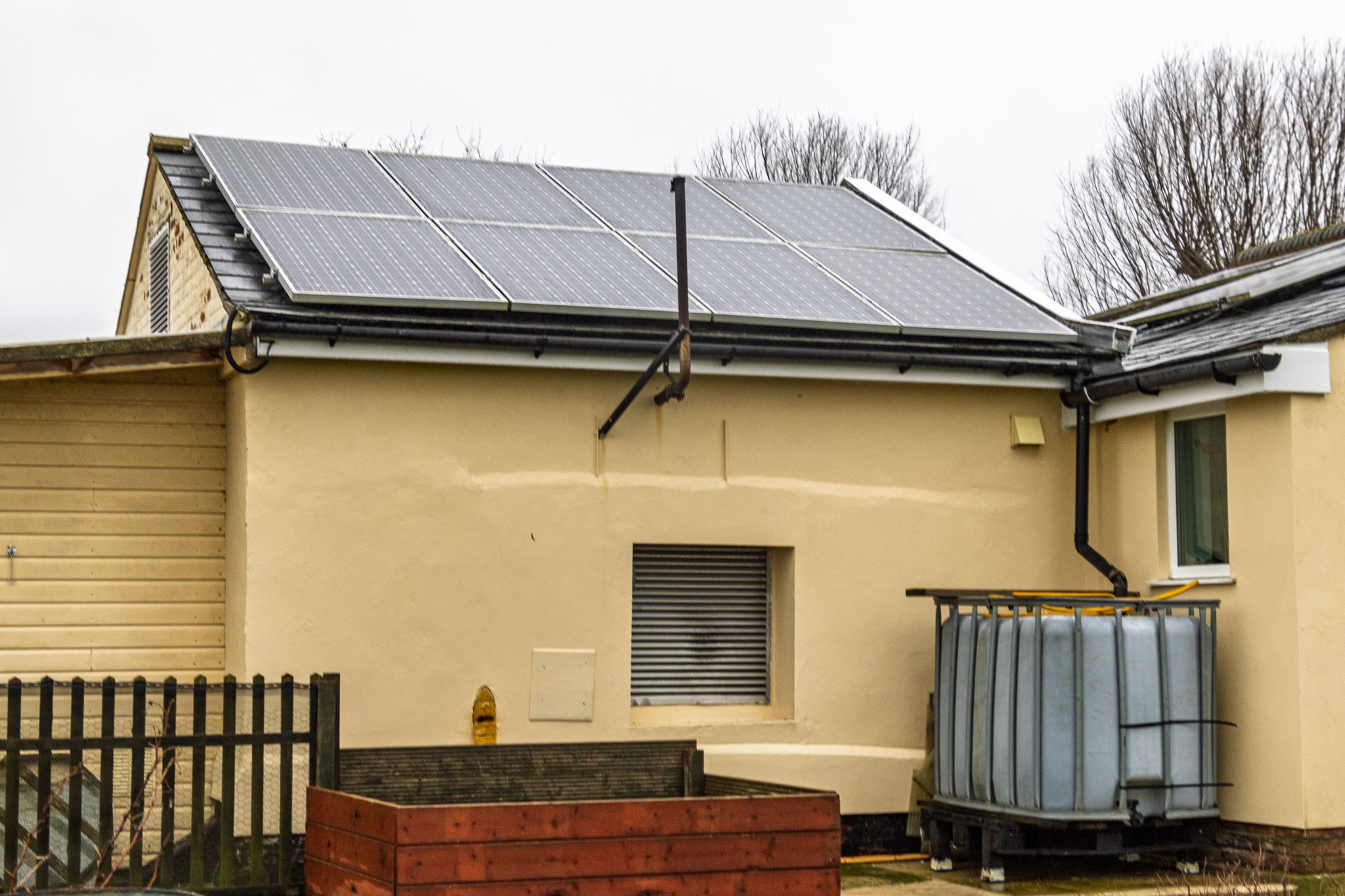
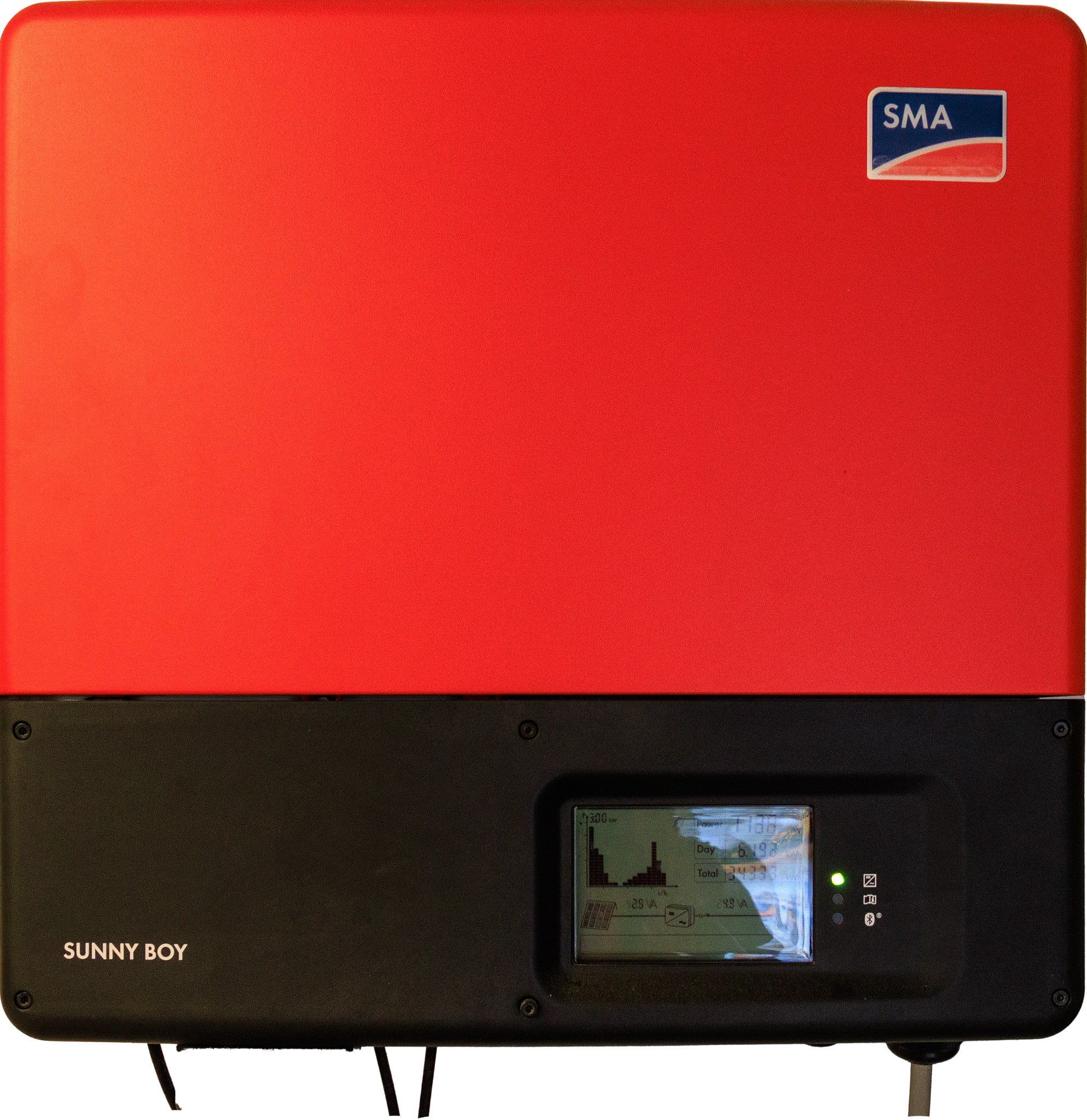 The wind turbine worked very well, and still does, but it was not producing enough to prevent the engine running too often. Frequently on days when there was little wind there was a lot of sun. Also the price of solar panels had come down greatly. So in early 2012 we sourced and self installed some Solar panels — 1.25kWp on the engine shed roof along with a small inverter as an experiment at a cost of £2,400. That was very successful so later in that year Able Energy (who have since ceased trading) installed a further 2.75kWp and a larger inverter at a cost of £4,800. We now have 2kWp on the engine shed roof facing almost directly South and 2kWp on the roof of the extension facing almost directly West. The installation was commissioned in October 2012. The device registered with SMA, see the online Service Centre https://my.sma-service.com/s/?language=en_US.
Between March 2012 and December 2024 the Solar Panels generated ~80MWh of electricity, approximately 6.3MWh a year. Almost double the output of the wind turbine!
Sunny Island
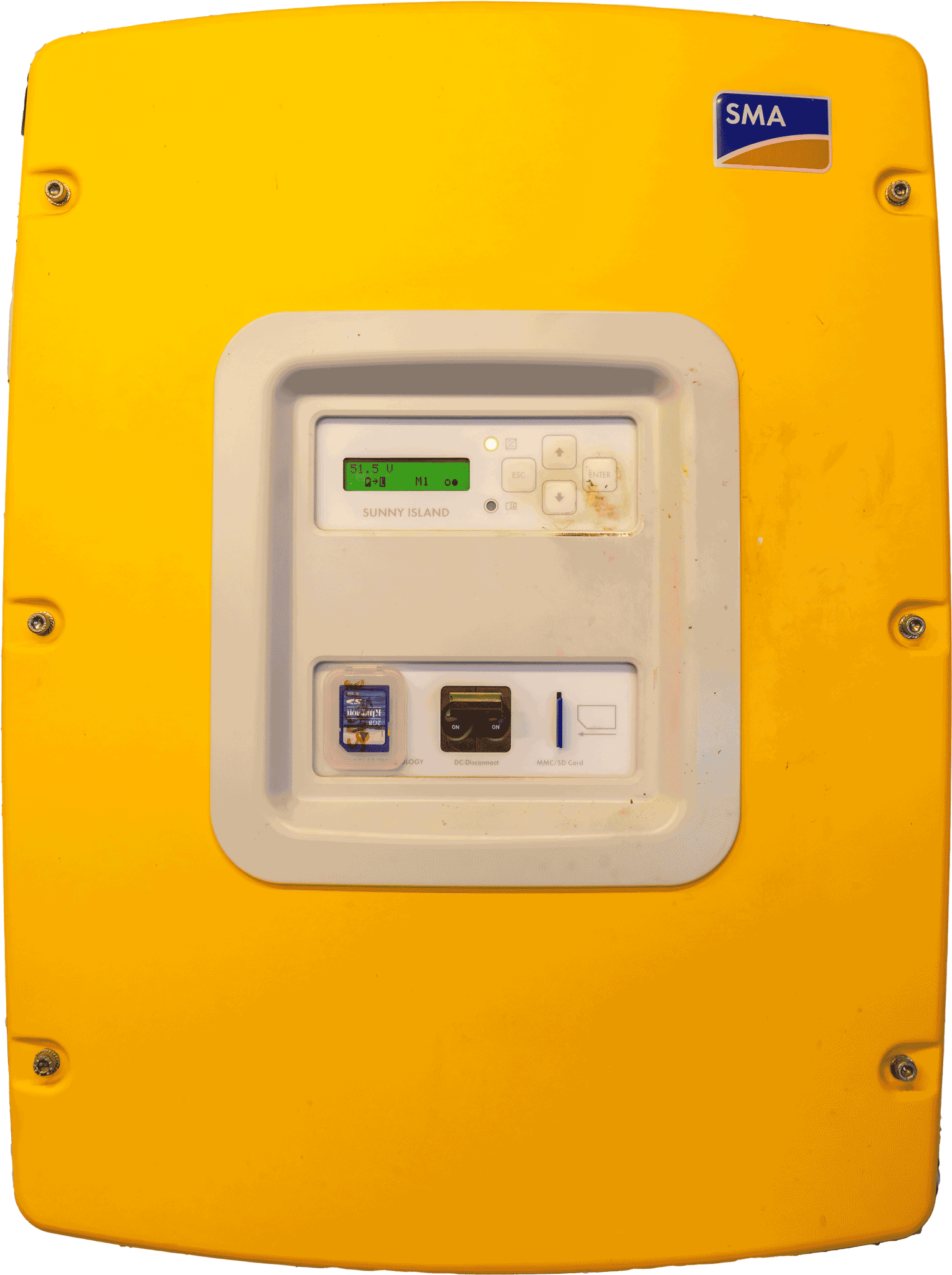 When the wind turbine/solar panels are generating they deliver electricity to the house and charge the batteries. If they are not generating enough to satisfy the power demanded by the house the batteries must make up any deficit. If the wind turbine/solar panels are not generating and the diesel generator is not running then all electricity to the house is provided by the batteries. If the batteries become discharged below 30%, the diesel generator is automatically started to recharge them up to 90%. This recharge normally takes ~7 hours. All of this control is automatic and controlled by the Sunny Island.
If the wind turbine/solar panels are generating more than the house is demanding the excess power is used to charge the batteries. If the wind turbine is generating more than the house requires and more than can be stored in the batteries, the control equipment backs off the wind turbine and it spins freely. We try to avoid this situation by manually switching on the immersion heater and / or electric fires / washing machine etc. Clearly this means we need to keep a close eye of the equipment as we do not want that equipment to be discharging the batteries unnecessarily. We used to have some control equipment for this, a number of Distributed Intelligent Load Controllers, but they failed and we are yet to find suitable replacements (March 2023).
Batteries
The Battery
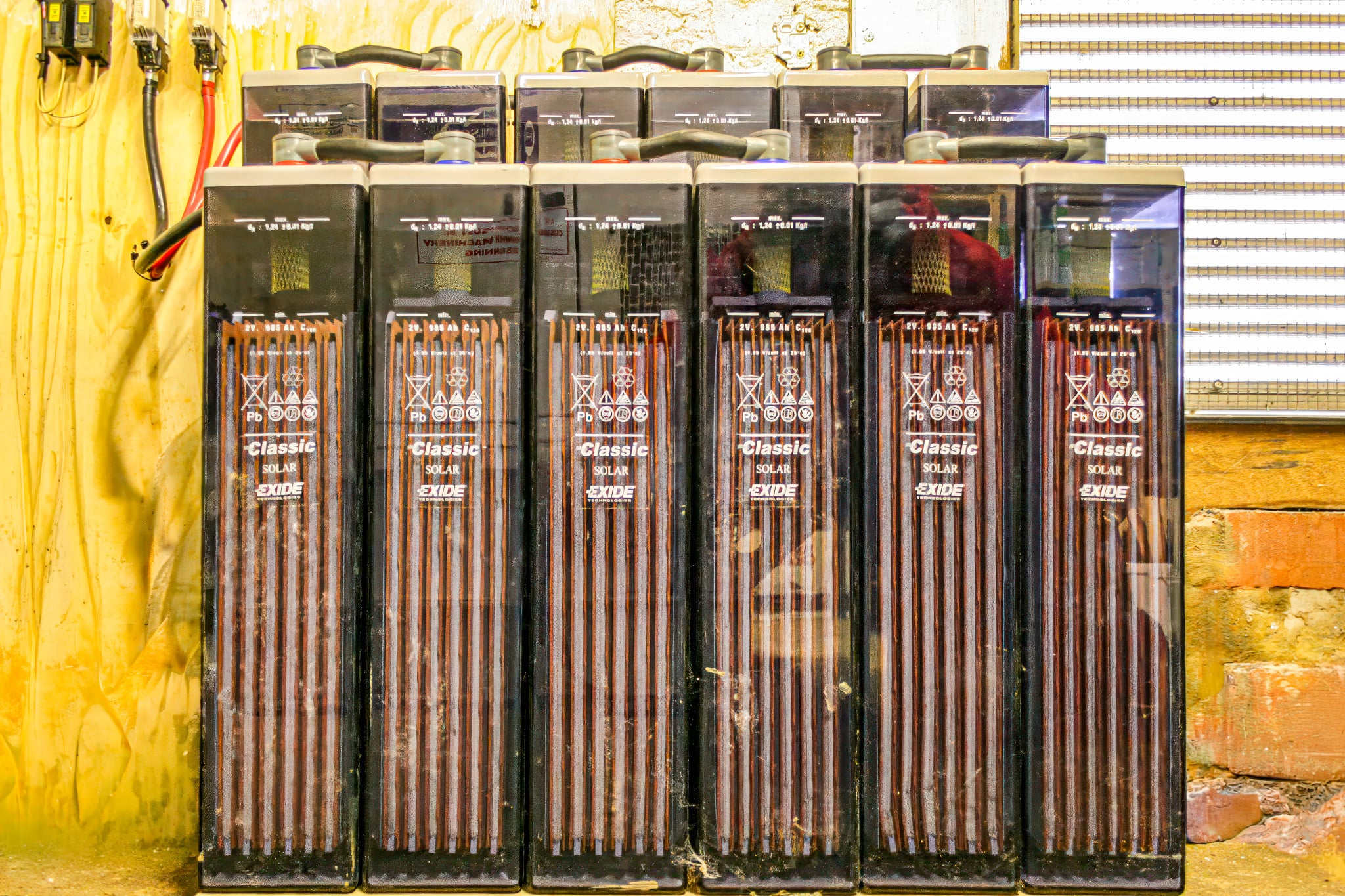 In 2006 when we replaced the existing power system with a wind turbine and SMA equipment we also replaced the battery. The existing cells comprising the battery were badly sulphated due to not having an appropriate charge / discharge regime and with only 12 cells made a 24V battery which was inadequate for our new system.
We chose, and had installed at the same time as the wind turbine, 24 off Classic Solar Exide OPzS cells to give a nominal 48V battery. The nominal capacity at C10 was 769.5 Amps. There were the same cells as the previous 24V set up.
In hindsight it was not a good choice, whilst the charge / discharge regime of the SMA equipment is supposed to ensure their longevity. In 2016/2017 after only ~11 years’ service. we started experiencing a number of issues with the battery including overheating and a failure of the Sunny Island. One cell had to be removed from the battery.
Replacing the Battery
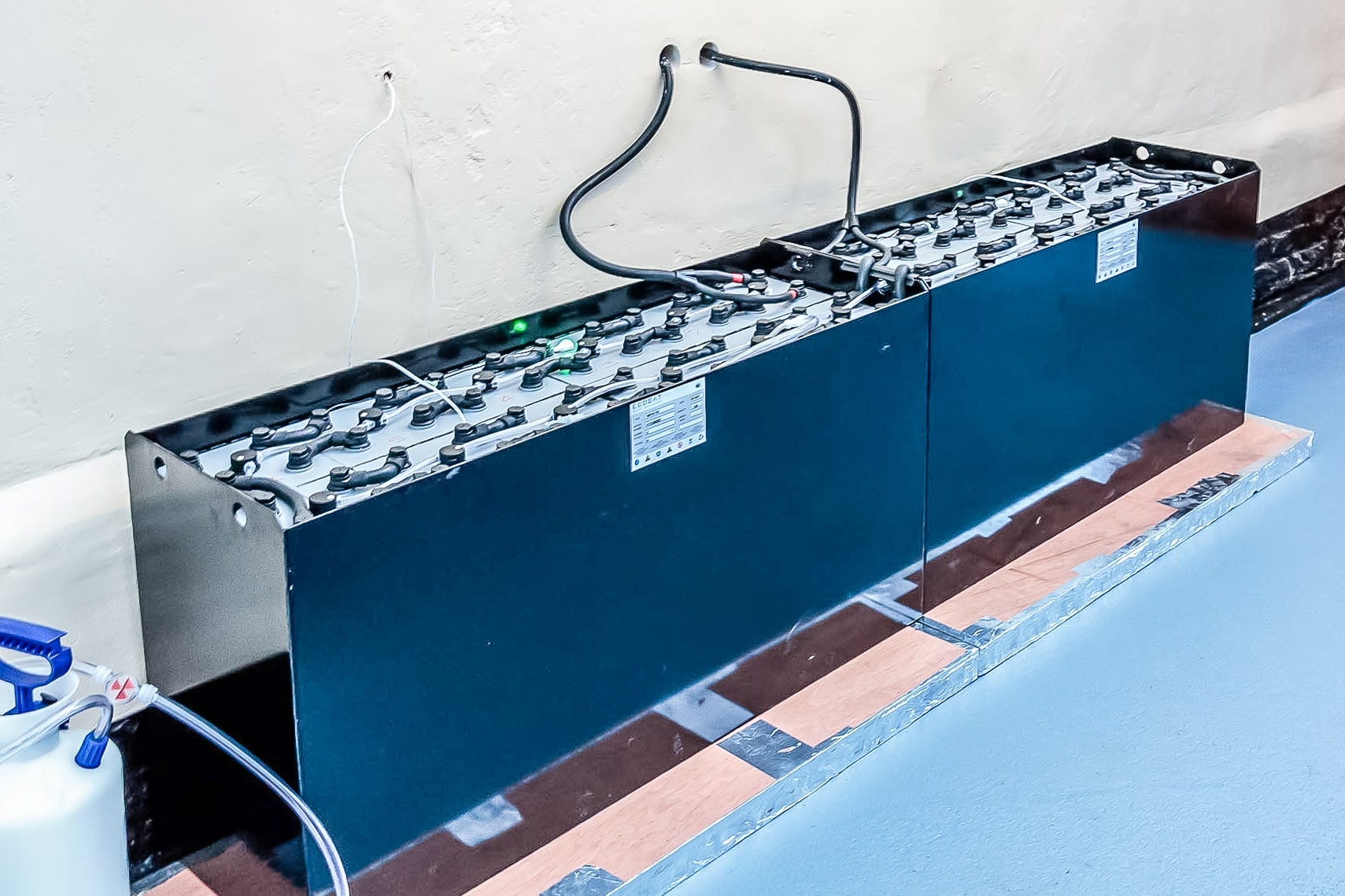
Whilst a lithium-ion battery might have been a good choice we had to stay with lead-acid technology because that was the only one that the Sunny Island could handle. After much research and advice — there are a confusing number of different lead-acid battery configurations — we chose traction batteries from ManBat / EcoBat. In November 2017 they installed 24 off TAB 10Pz21150L cells and a central watering system for just over £6K. The battery’s nominal capacity at C10 is 1,275 Amps. Some ~65% more than the battery we were replacing.
As of now (May 2025 ~ 8 years in) the batteries continue to perform well.
Diesel Generator
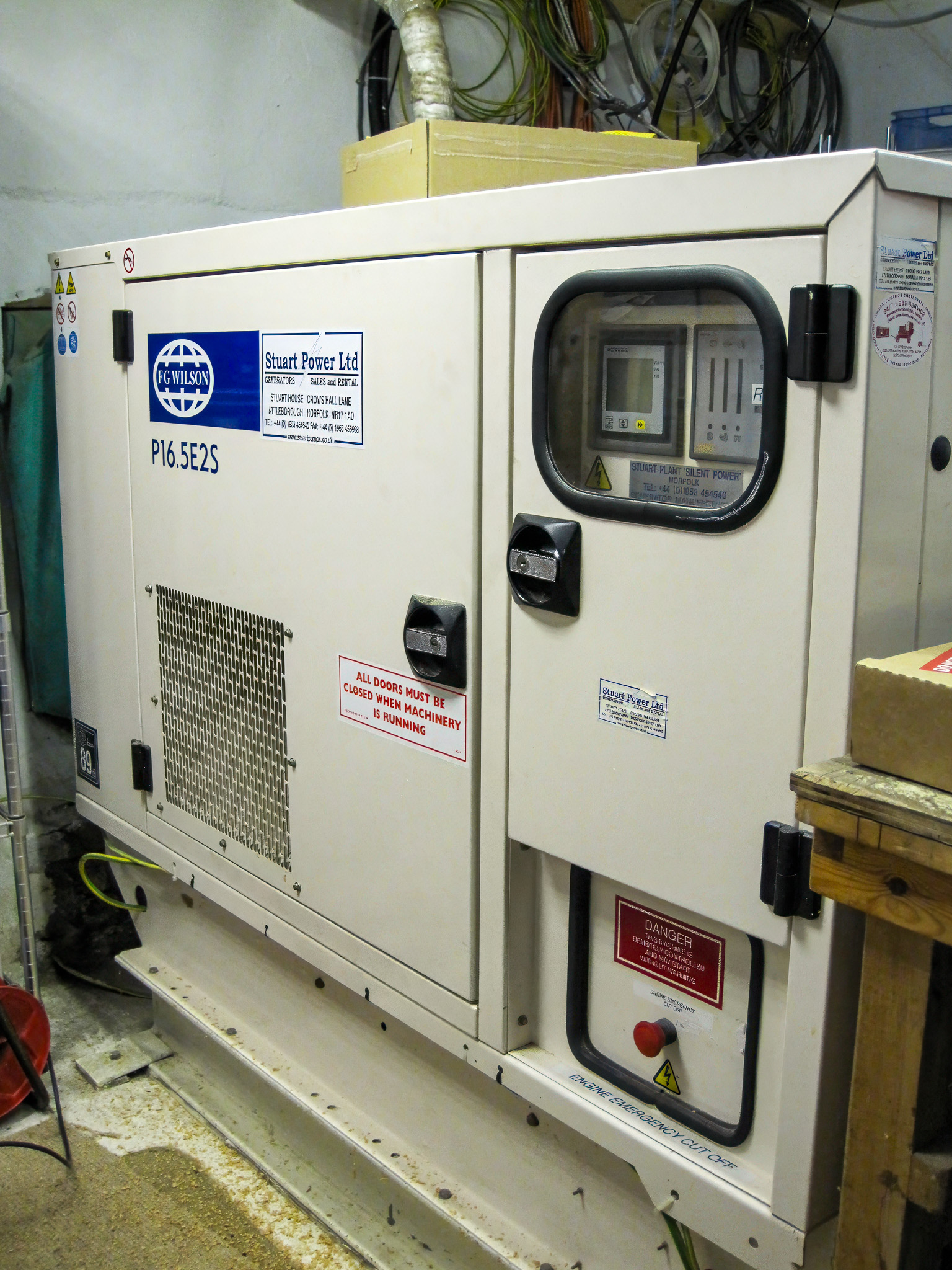 We kept the 16.5 kVA diesel generator set (Model P16.5ES s/n FGWPEP06LPD) which was in the house when we arrived and it has been running well ever since. As of the end of 2024 it had run for over 15,600 hours, the equivalent of over ¾ of a million miles at 50mph. We have it regularly maintained. With the power supplied by the wind turbine and solar panels the engine now runs for between 200 and 250 hours a year compared with 400-550 Hours PA without the solar panels and vastly more when we had no green energy at all.
The generator set consists of a Perkins diesel engine (type HP51119U s/n 974668K -- manufactured in 2003) connected to a Leroy Somer alternator (s/n 14782/01) with an access 2000 control panel. It produces 16.5kVA. on a single 50Hz phase at 230 volt, We try to run it under as much load as possible to prevent cokingThe build-up of unwanted carbon deposits, primarily in the fuel injector nozzles, caused by high temperatures and oil residue. This build-up can restrict fuel flow, reduce engine performance, and lead to various problems like excessive smoke, loss of power, and engine knocking..
The previous owner was badly advised and had the engine installed along with a small inverter and 12v backup battery. There is a remote starting device on the house which was used when any amount of electricity was needed. The meant that the diesel engine ran for long periods under very lightly loaded causing cokingThe build-up of unwanted carbon deposits, primarily in the fuel injector nozzles, caused by high temperatures and oil residue. This build-up can restrict fuel flow, reduce engine performance, and lead to various problems like excessive smoke, loss of power, and engine knocking.. To rectify that we had to run the engine with a large dummy load for a period to burn off the deposits.
When the diesel engine does run, there is plenty of electricity available. The immersion heater is connected to the generator. So when the generator runs we have plenty of hot water. If it doesn't run we need to use either excess wind or solar power or the LPG boiler to provide hot water.